The internet has never had more content than it does today.
Thanks to AI writing tools, anyone can publish hundreds of articles in a matter of hours. Unfortunately, much of that content repeats the same ideas already ranking on Google’s first page.
That creates a new challenge for website owners and marketers.
If everyone is saying the same thing, why should Google rank your page?
This is where Information Gain has become one of the most important concepts in modern SEO.
Instead of creating another version of existing content, successful websites contribute something new. That could be original research, firsthand experience, unique data, expert opinions, or practical insights that readers can’t easily find elsewhere.
In this guide, you’ll learn what Information Gain means, why it matters, how it relates to Google’s focus on helpful content, and practical ways to create content that both users and search engines value.
What Is Information Gain in SEO?
Information Gain refers to the new value your content adds beyond what’s already available online.
Imagine Google has already indexed thousands of articles answering the same question.
If your article simply rewrites those existing ideas, it contributes very little.
However, if your content includes:
- Original research
- Personal experience
- Expert interviews
- Unique statistics
- Case studies
- Real-world testing
- New frameworks
- Practical insights from your own projects
Then you’re increasing the amount of useful information available to searchers.
Think of it this way.
Low Information Gain
“Keyword research helps you find search terms people use.”
You’ve probably read that sentence hundreds of times.
High Information Gain
“After analyzing 1,200 keywords across 18 client websites, we found that informational keywords created 4.7 times more internal linking opportunities than commercial keywords.”
That’s information readers are unlikely to find in competing articles.
Is Information Gain a Google Ranking Factor?
This is an important distinction.
Information Gain is not a confirmed Google ranking factor.
The concept became widely discussed after Google published a patent describing ways a search engine could prioritize documents that introduce new information compared to content a user has already seen.
However, Google has never confirmed that this patent is directly used in Search rankings.
Instead, Information Gain should be viewed as a concept that aligns closely with Google’s broader goal of rewarding helpful, original, people-first content.
Whether or not the patent is actively used, creating genuinely useful content is a strategy that benefits both readers and long-term SEO performance.
Why Information Gain Matters More Than Ever
AI tools are incredibly good at summarizing existing information.
What they struggle to produce is something genuinely original.
Google doesn’t need another article saying:
- SEO takes time.
- Content is king.
- Use keywords naturally.
Thousands of pages already cover those ideas.
Instead, search engines increasingly reward pages that provide:
- New perspectives
- Helpful examples
- Practical insights
- Original evidence
- Firsthand experience
- Demonstrated expertise
The easiest content to create has become the hardest content to rank.
Information Gain and E-E-A-T
Information Gain naturally complements Google’s E-E-A-T principles.
Experience often creates Information Gain because it introduces knowledge that cannot be copied from existing articles.
For example, anyone can explain how to migrate a website.
Far fewer people can explain what happened after migrating a 3,000-page website, what mistakes occurred, how rankings changed, and what they learned throughout the process.
That’s real experience, and it creates unique value for readers.
The more genuine experience you include, the more difficult your content becomes to replicate.
Why AI Content Often Falls Short
Most AI-generated articles follow a similar process:
- Analyze top-ranking pages.
- Identify common topics.
- Rewrite those ideas.
- Publish.
The result is often polished and readable.
But it rarely contributes anything new.
This creates what many SEO professionals call content homogenization, where every article begins to sound almost identical.
Readers notice.
Search engines notice too.
What AI Can’t Easily Reproduce
AI is excellent at summarizing public knowledge.
It struggles to reproduce information that isn’t publicly available.
1. Firsthand Experience
Real examples from projects you’ve personally worked on.
Example:
“After migrating a 3,000-page website, organic traffic dropped by 28% before recovering after 45 days.”
2. Original Data
Publish findings from:
- Client campaigns
- Surveys
- Website analytics
- Internal research
- Industry studies
Even small datasets can make your content unique.
3. Original Screenshots
Instead of describing a process, show it.
Include:
- Google Search Console reports
- Google Analytics screenshots
- Crawl reports
- Before-and-after comparisons
- Heatmaps
Visual evidence builds trust and is much harder to duplicate.
4. Honest Failures
Everyone shares success stories.
Few explain what failed.
Content discussing mistakes, unexpected outcomes, and lessons learned often provides more value than another list of best practices.
5. Personal Frameworks
Create memorable systems that organize your expertise.
For example, instead of simply saying:
Improve content quality.
You could introduce a framework like:
6. The 5I Framework
- Intent
- Insight
- Illustration
- Implementation
- Improvement
The concepts themselves may not be entirely new, but packaging them into a memorable framework increases your content’s uniqueness.
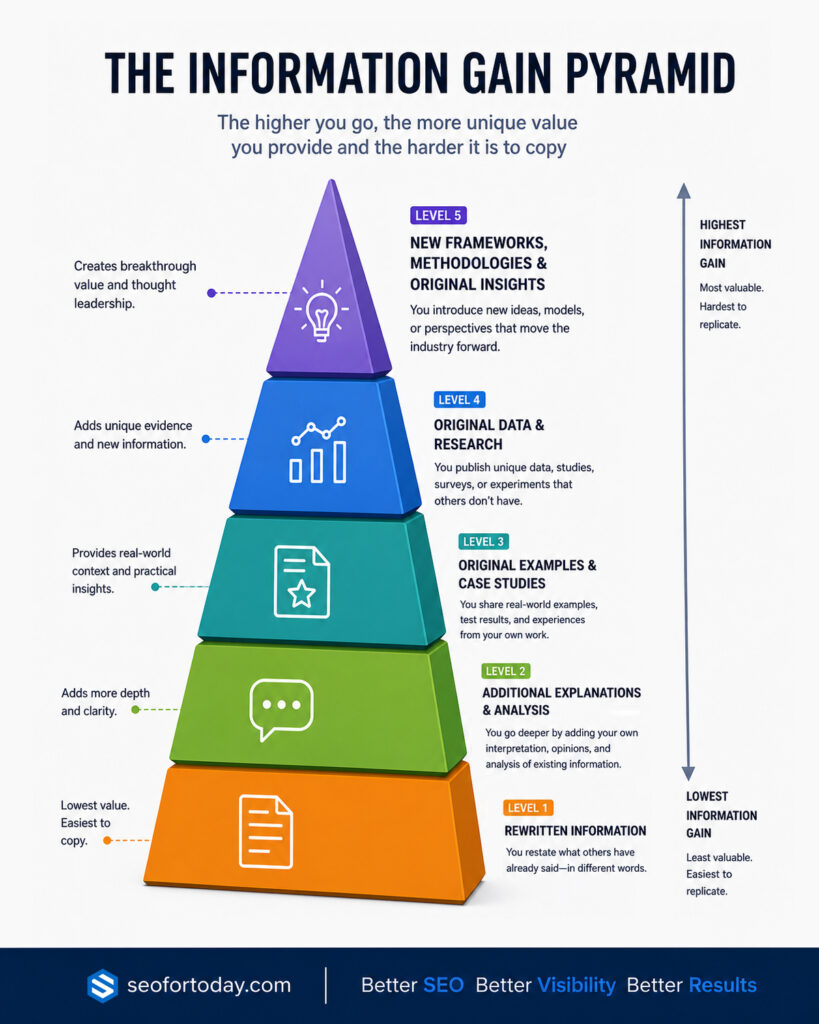
The Information Gain Pyramid
Think of Information Gain as a pyramid.
Level 1
Rewritten information
↓
Level 2
Additional explanations
↓
Level 3
Original examples
↓
Level 4
Original data and research
↓
Level 5
New frameworks, methodologies, and insights
The higher you move up the pyramid, the more difficult your content becomes for competitors or AI tools to replicate.
Practical Ways to Increase Information Gain
1. Share Your Own Results
Readers trust evidence.
Instead of writing:
“Internal links improve SEO.”
Write:
“Adding contextual internal links increased crawl frequency by 37% across 42 articles on our website.”
Specific numbers build credibility.
2. Create Original Visual Assets
Don’t rely entirely on stock photos.
Create:
- Custom diagrams
- Comparison tables
- Workflows
- Charts
- Annotated screenshots
Original visuals make your content more engaging while increasing Information Gain.
3. Include Expert Opinions
Interview professionals whenever possible.
Even a short quote from an SEO consultant, developer, or content strategist introduces information competitors may not have.
4. Publish Mini Case Studies
Case studies remain one of the strongest forms of Information Gain.
Rather than saying:
“Improve page speed.”
Show:
- The original performance
- The changes you made
- The final results
- What surprised you
5. Explain the “Why”
Many articles stop after giving instructions.
Go further.
Instead of saying:
“Compress images.”
Explain:
- Why it matters
- When it makes the biggest impact
- Situations where it may not help
- Potential trade-offs
Depth creates differentiation.
6. Challenge Common Assumptions
If you’ve tested something that contradicts popular SEO advice, share it with evidence.
Balanced, well-supported opinions often become the most memorable sections of an article.
Information Gain vs. Content Length
Longer content isn’t automatically better.
A 6,000-word article repeating existing ideas may provide less value than a concise 1,500-word guide containing original research and practical experience.
Instead of asking:
“How can I make this article longer?”
Ask:
“What can I add that readers won’t find anywhere else?”
That’s the better SEO question.
Generic Content vs. High Information Gain
| Generic Content | High Information Gain |
|---|---|
| Rewrites competitor articles | Shares original findings |
| Uses stock images | Uses original screenshots |
| Gives advice | Shows evidence |
| Repeats common knowledge | Introduces new frameworks |
| Easy for AI to reproduce | Difficult to replicate |
The 7 Question Information Gain Test
Before publishing, ask yourself:
- Does this article include something readers won’t find elsewhere?
- Am I sharing real experience instead of theory?
- Have I added original examples or evidence?
- Does it contain original visuals?
- Have I answered questions competitors overlooked?
- Could AI easily recreate this article from existing search results?
- Would someone bookmark this page because they learned something new?
If most answers are “no,” your content probably needs more Information Gain.
Common Mistakes to Avoid
- Rewriting Competitor Articles: Changing the wording doesn’t create originality.
- Publishing AI Drafts Without Editing: AI should accelerate your workflow, not replace your expertise.
- Chasing Word Count: Quality consistently beats quantity.
- Ignoring Real Examples: Readers trust evidence far more than generic advice.
Information Gain and Topical Authority
Information Gain works best as part of a broader content strategy.
When your website consistently publishes original insights across an entire subject, you gradually build topical authority.
Over time, search engines become more confident that your website provides reliable expertise rather than recycled information.
Instead of publishing one exceptional article, aim to make originality a consistent characteristic across your entire website.
The Future of SEO Belongs to Originality
As AI-generated content continues to flood the web, originality becomes a competitive advantage.
The websites earning long-term organic traffic won’t necessarily publish the most content.
They’ll publish the most useful content.
Information Gain isn’t about writing longer articles.
It’s about giving readers a reason to stop searching because they’ve found something genuinely new.
If AI can recreate your article simply by summarizing the top ten search results, your content probably doesn’t offer enough Information Gain.
But if your article shares original research, real experience, unique evidence, or a fresh perspective, you’ve created something that’s valuable for both readers and search engines.
Key Takeaways
- Information Gain is the unique value your content adds beyond existing pages.
- It is a concept inspired by Google’s research, not a confirmed ranking factor.
- Original research, firsthand experience, case studies, and custom visuals are among the strongest ways to increase Information Gain.
- AI can summarize existing knowledge but struggles to reproduce genuine expertise and original evidence.
- Focus on helping readers learn something new instead of simply publishing longer articles.
- The future of SEO belongs to creators who combine expertise, originality, and practical experience.